













Transaction Center
Time to bring it home. Find zipForm®, transaction tools, and all the closing resources you'll need. Except for the champagne — that's on you.
View the latest sales and price numbers. Find out where sales will be in upcoming months.
Get a roundup of weekly economic and market news that matters to real estate and your business.
Gain insights through interactive dashboards and downloadable infographic reports.
All Shareable Reports All Interactive DashboardsCatch up with the latest outreaches and webinars by the Research and Economics team.
C.A.R. conducts research with members and consumers on a regular basis to get a better understanding of the housing market and the real estate industry.
California Model MLS Rules, Issues Briefing Papers, and other articles and materials related to MLS policy.
Looking for information on how to file an interboard arbitration complaint? You've come to the right place! Find the rules, timeline and filing documents here.
Summaries and photos of California REALTORS® who violated the Code of Ethics and were disciplined with a fine, letter of reprimand, suspension, or expulsion.
The most recent edition of the Code of Ethics and Standards of Practice of the National Association of REALTORS® along with other important links to NAR information.
The California Professional Standards Reference Manual, Local Association Forms, NAR materials and other materials related to Code of Ethics enforcement and arbitration.
Designed to expand housing access, Proposition 37 proposes a $25 billion state bond program providing eligible middle-income homebuyers with fixed-rate second mortgages covering up to 17% toward the purchase of newly constructed homes.
Updates on C.A.R.'s legislative advocacy efforts in Sacramento.
Ballot MeasuresIssues briefing papers, handbooks and other background materials on local policy issues that affect real estate.
CREPAC, LCRC, IMPAC, ALF and the RAF comprise C.A.R.'s political fundraising arm.
The RAA: Protecting REALTORS® and Homeownership REALTOR® Action FundC.A.R. Senior Vice President of Government Affairs Sanjay Wagle sits down with California Insurance Commissioner Ricardo Lara to discuss the current state of California’s insurance market,
Learn how you can make a difference, by getting involved yourself or by passing along valuable information to your clients.


|
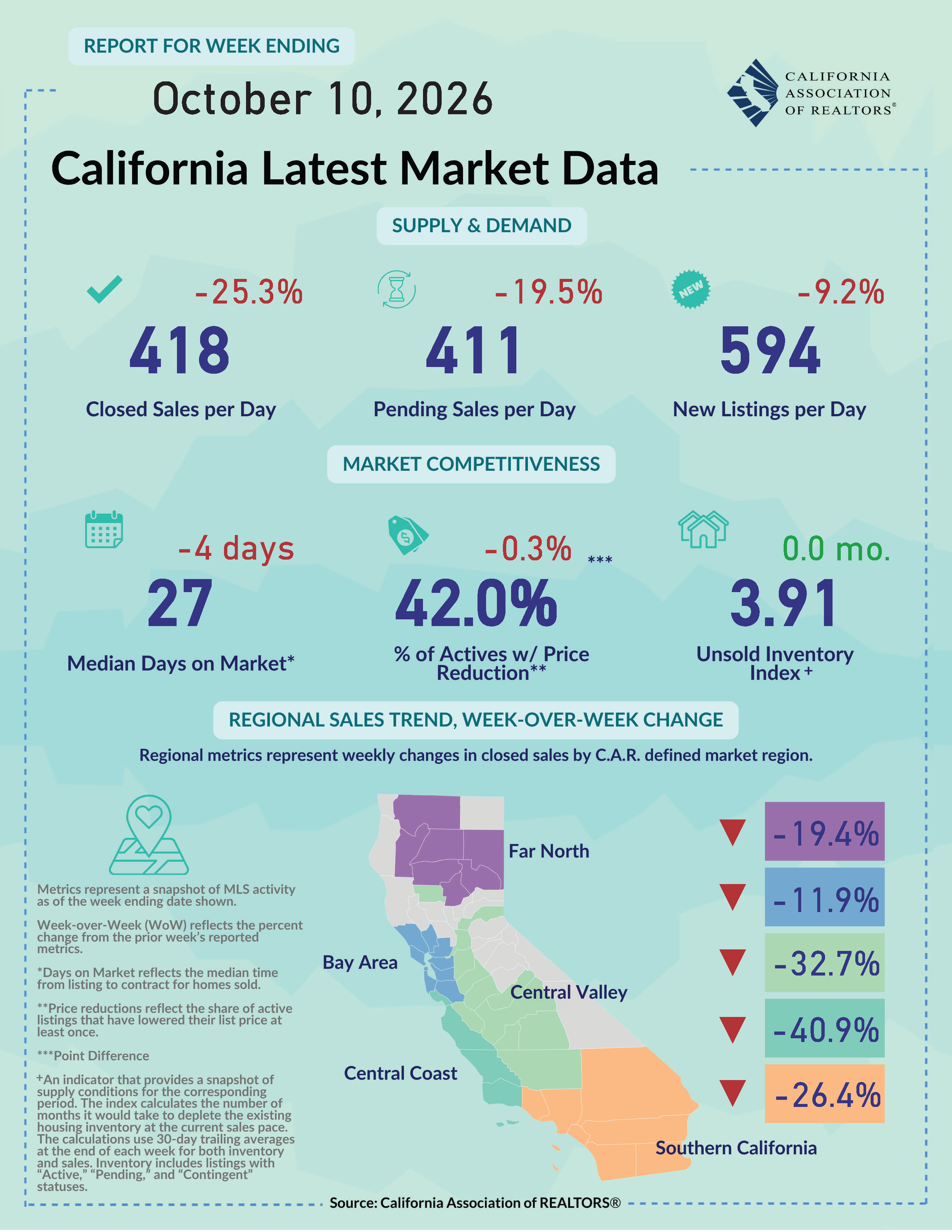
October 12, 2026 - Despite near-term headwinds from elevated inflation, geopolitical tensions, high borrowing costs, and cautious consumer and investor activity, the outlook for 2027 released by the C.A.R. last week remains positive. Recent improvements in labor-market expectations, resilient remodeling sentiment, and growing use of AI to enhance real estate productivity point to some positives the market can focus on in coming months. As uncertainty subsides and mortgage rates ease, California home sales are expected to rise modestly, with limited inventory supporting slight price growth.. Modest home price growth expected for California in 2027: Home sales are forecast to rise in 2027 as the state's housing market continues its gradual recovery, according to the latest housing forecast released by the CALIFORNIA ASSOCIATION OF REALTORS® (C.A.R.). The baseline scenario of C.A.R.’s “2027 California Housing Market Forecast” sees an increase in existing single-family home sales of 3.7% next year to reach 277.9k units, up from the projected 2026 annual sales figure of 268.1k. The projected 2026 figure is 1.1% lower compared with the pace of 271,1k homes sold in 2025. The California median home price is expected to edge up 1.4% to $894,400 in 2027, following a projected 0.8% increase to $882,200 in 2026 from $875,600 in 2025. A continual shortage of homes for sale will remain a defining factor. That imbalance between supply and demand should provide upward support for home prices but also limit the pace of overall market growth. While the market is expected to remain subdued through the end of 2026, demand is anticipated to improve modestly in 2027 as geopolitical tension eases and economic uncertainty subsides. As confidence picks up and mortgage rates ease, buyers who have been waiting on the sidelines are expected to jump back to the market in 2027. Short-term inflation expectations reached 40-month high as labor outlook improved: Inflation expectations for the near term climbed to the highest level in more than three years in September as consumers remained concerned about high energy prices, according to the New York Fed’s Survey of Consumer Expectations. Despite crude oil prices showing some improvement in the second half of September, the median inflation expectations at the one-year ahead horizon rose to 3.9% and reached the highest level since May 2023. Gas prices staying sharply higher than pre-war levels while a ceasefire agreement being nowhere in sight are contributing factors to the rise in expectations. Meanwhile, home price growth expectations were unchanged, with the median moving side way and recorded a 3% growth pace. On the other hand, perception about the labor market seems more positive, with consumers’ expectations on unemployment rate, job finding, job loss, and quit rate all improving. The mean unemployment expectations, for example, decreased by 0.5 percentage point to 43.9%, but remained above their 12-month trailing average. With the economy showing signs of resilience in recent months, overall prices may remain stubbornly high until the war in the Middle East ends. Homes purchased as investments dip as rental market remains soft: C.A.R.’s 2026 Housing Market Survey shows that homes purchased for investment purposes accounted for 10.9% of sales, down to the smallest share of total sales in the past five years. High home prices and elevated borrowing costs have discouraged investment purchases by making potential returns harder to justify. Notably, the rental portion of investment purchases fell to 58.6%, its lowest level in at least 16 years. This shift underscores the challenging rental environment property owners have faced in recent years, as soft rental conditions make it harder to generate enough income to cover acquisition and financing costs. The median price for investment property reached $797,500 in 2026, an increase of 8.5% from $735,000 in 2025, illustrating the higher entry cost. Detached single-family homes represented 67.7% of investment purchases, and suburbs remained the most common location at 39.4%. REALTORS® use AI to save time and streamline workflow: The National Association of REALTORS®' 2026 REALTORS® Technology Report highlights the growing role of artificial intelligence (AI) in real estate, with many agents and brokers adopting AI as part of their mainstream business use over the past 12 months. Nearly half of REALTORS® use AI on a regular basis, including 23% who use it daily and 25% who use it weekly. One in ten (12%) of them, however, are not using AI and do not plan to use it in the future. While over half (55%) of respondents said AI has had a positive impact on their business, one out of ten (11%) of them indicated that there was negative impact on their business due to AI. Of all the AI tools being used, ChatGPT (91%) is the most popular platform, followed by Gemini (42%), Copilot (27%), and Claude (25%). REALTORS® most commonly use AI to write listing descriptions (75%), create social media content (56%), and draft emails and follow-up communications (52%). Over the next 12 months, more than half of REALTORS® (54%) plan to use generative AI for content creation and 48% are interested in using AI-powered lead generation and follow-up to enhance their real estate business. Overall, the survey suggests that AI is becoming an increasingly important tool for helping agents work more efficiently, automate routine tasks, and improve client experience. Remodeling sentiment unchanged despite headwinds: Remodeling market sentiment remained stable in Q3 despite high material costs and continuing labor shortage, according to the National Association of Home Builders (NAHB) Remodeling Market Index (RMI). The RMI inched up one point to 62 from 61 in Q2 and remained above the 50 threshold that signals more remodelers view conditions as good than poor. Current market conditions were unchanged for the third consecutive quarter as the component for large projects improved but those of moderately-sized and small projects both inched down in Q3 from the prior quarter. On the other hand, future indicators index went up by two points, with the sub-indicators of leads/inquiries and backlogs both went up two points in the current quarter. Despite the slight gain in the latest report, remodelers reported that economic uncertainty is putting some potential customers on hold and delaying projects from moving forward. Note: This summary report gets updated every Monday by 6:00 pm PST. Feel free to email us at [email protected] if you have any questions and/or feedback.
|
|